
SAST Integration
Overview
SAST Integration is my thesis project, currently at milestone M4 of a larger roadmap. It is a security platform for managing static-analysis workflows across workspaces, built on Next.js 16, Ant Design, and Drizzle. The foundation that is implemented and tested covers authentication, sessions, workspace multi-tenancy, teams, and a role hierarchy. The data model is the furthest along: a 41-table schema that already maps the full SAST and AI-verification domain. The scanning pipeline and the AI verification layer are the next milestones, designed in the schema and documented in the roadmap but not yet built.
Problem
- Static-analysis tools drown developers in false positives that must be triaged by hand
- No single platform ties multiple scanners to verified findings in a collaborative workspace
- A thesis needs a research-grade platform whose data model supports the full problem even before every part ships
Goal
- Build a secure multi-tenant platform with rock-solid authentication as the foundation
- Design a database that models scanners, findings, AI verification, reports, and webhooks end to end
- Implement workspace and team management with a role hierarchy
- Keep the SAST scanning and AI-verification milestones on the roadmap with the data model ready
Role
I am building the entire platform independently, covering full-stack development, security, and the AI research agenda. Team: Achmad Raihan Fahrezi Effendy (Full-Stack Developer, thesis)
Architecture
flowchart TD
    A["Next.js 16 App Router"] --> P["proxy.ts (route guard)"]
    P --> B["Auth (JWT access + refresh)"]
    B --> C["Workspace module"]
    B --> D["Members + teams"]
    B --> E["RBAC roles"]
    C --> F["Drizzle ORM"]
    F --> G[("PostgreSQL")]
    H["Scanner workers (roadmap)"] --> F
    I["AI verification (roadmap)"] --> F

    subgraph implemented["Implemented (M1-M4)"]
        A
        P
        B
        C
        D
        E
        F
        G
    end

    subgraph planned["Planned (M5+)"]
        H
        I
    end
The implemented surface is auth, sessions, workspaces, members, and role levels. The SAST and AI modules exist as schema and roadmap entries, ready to be wired next.
Database Design
The 41-table schema is the real core of the thesis. Identity and workspace tables use camelCase columns; the planned SAST domain uses snake_case. This is a subset showing both sides: the multi-tenant foundation that works today, and the scanner and AI tables that the next milestone fills.
erDiagram
    users ||--o{ sessions : "sessions"
    users ||--o{ workspace_members : "joins"
    workspaces ||--o{ workspace_members : "members"
    workspaces ||--o{ workspace_invitations : "invites"
    workspaces ||--o{ projects : "owns"
    projects ||--o{ scans : "scanned"
    scans ||--o{ scan_results : "results"
    scans ||--o{ findings : "finds"
    findings ||--o{ ai_verifications : "verified"
    workspaces ||--o{ teams : "teams"
    teams ||--o{ team_members : "members"
    permissions ||--o{ role_permissions : "role map"
    users ||--o{ user_permissions : "overrides"

    users {
        uuid id PK
        varchar email UK
        text password_hash
        timestamp email_verified_at
        uuid current_workspace_id
    }
    sessions {
        varchar id PK
        uuid user_id FK
        varchar ip_address
        text user_agent
    }
    workspaces {
        uuid id PK
        varchar name
        varchar slug UK
        varchar type "personal / organization"
    }
    workspace_members {
        uuid id PK
        uuid workspace_id FK
        uuid user_id FK
        varchar role "owner / manager / reviewer / member"
    }
    workspace_invitations {
        uuid id PK
        uuid workspace_id FK
        varchar email
        varchar role
        varchar token UK
        timestamp expires_at
    }
    teams {
        uuid id PK
        uuid workspace_id FK
        varchar name
        varchar slug
    }
    team_members {
        uuid id PK
        uuid team_id FK
        uuid user_id FK
        varchar role "admin / contributor"
    }
    permissions {
        uuid id PK
        varchar name UK
        varchar resource
        varchar action
    }
    role_permissions {
        uuid id PK
        varchar role
        uuid permission_id FK
    }
    projects {
        uuid id PK
        uuid workspace_id FK
        varchar name
        varchar platform
        varchar language
    }
    scans {
        uuid id PK
        uuid project_id FK
    varchar scanner "semgrep / gitleaks / flawfinder"
        jsonb scan_policies
    }
    scan_results {
        uuid id PK
        uuid scan_id FK
    }
    findings {
        uuid id PK
        uuid scan_id FK
        text cwe
        text severity
        text status
    }
    ai_verifications {
        uuid id PK
        uuid finding_id FK
        varchar verdict
        float confidence
        text explanation
        text fix_suggestion
        int latency_ms
    }
    ai_models {
        uuid id PK
        varchar provider "ollama / openai_compatible / groq"
        text base_url
        text prompt_preset
        varchar role
        int priority
    }
Auth & Workspace Flow
Authentication runs on JWT access and refresh tokens, with the refresh token in an httpOnly cookie and session rows checked on every request. Email verification and password reset use single-use tokens with rate limiting.
sequenceDiagram
    participant U as User
    participant W as Web (auth pages)
    participant P as proxy.ts
    participant A as AuthService
    participant D as PostgreSQL

    U->>W: Sign up
    W->>A: create account
    A->>D: Insert user (bcrypt 12) + verify token
    A->>U: Verification email
    U->>A: Confirm email
    A->>D: Set email_verified_at
    U->>W: Sign in
    W->>A: login
    A->>D: Create session + tokens
    A-->>W: Set refresh cookie
    W->>P: Enter /workspaces
    P->>A: Validate refresh token
    A->>D: Check session row
    A-->>W: Redirect to workspace
API
Twenty-four route handlers across 22 files, all auth and workspace.
Key Features
- JWT Auth with Refresh: Access and refresh tokens, httpOnly refresh cookie, session rows for signout invalidation
- Email Verification & Password Reset: Single-use tokens with rate limiting
- Workspace Multi-Tenancy: Personal and organization workspaces with a chooser UI
- Member Invites: Invite by email with role assignment and expiry
- Role Hierarchy: owner, manager, reviewer, and member enforced through workspace middleware
- Permission Catalog: 24 permissions and role mappings seeded in the database
- Route Guarding: Next.js 16
proxy.tsprotecting authenticated areas and redirecting guests - Env Hardening: Zod-validated environment that rejects default secrets in production
- Test Coverage: 131 tests across unit, e2e, and Playwright, all green
Roadmap
The schema and roadmap already define what comes next, even though the code does not implement it yet:
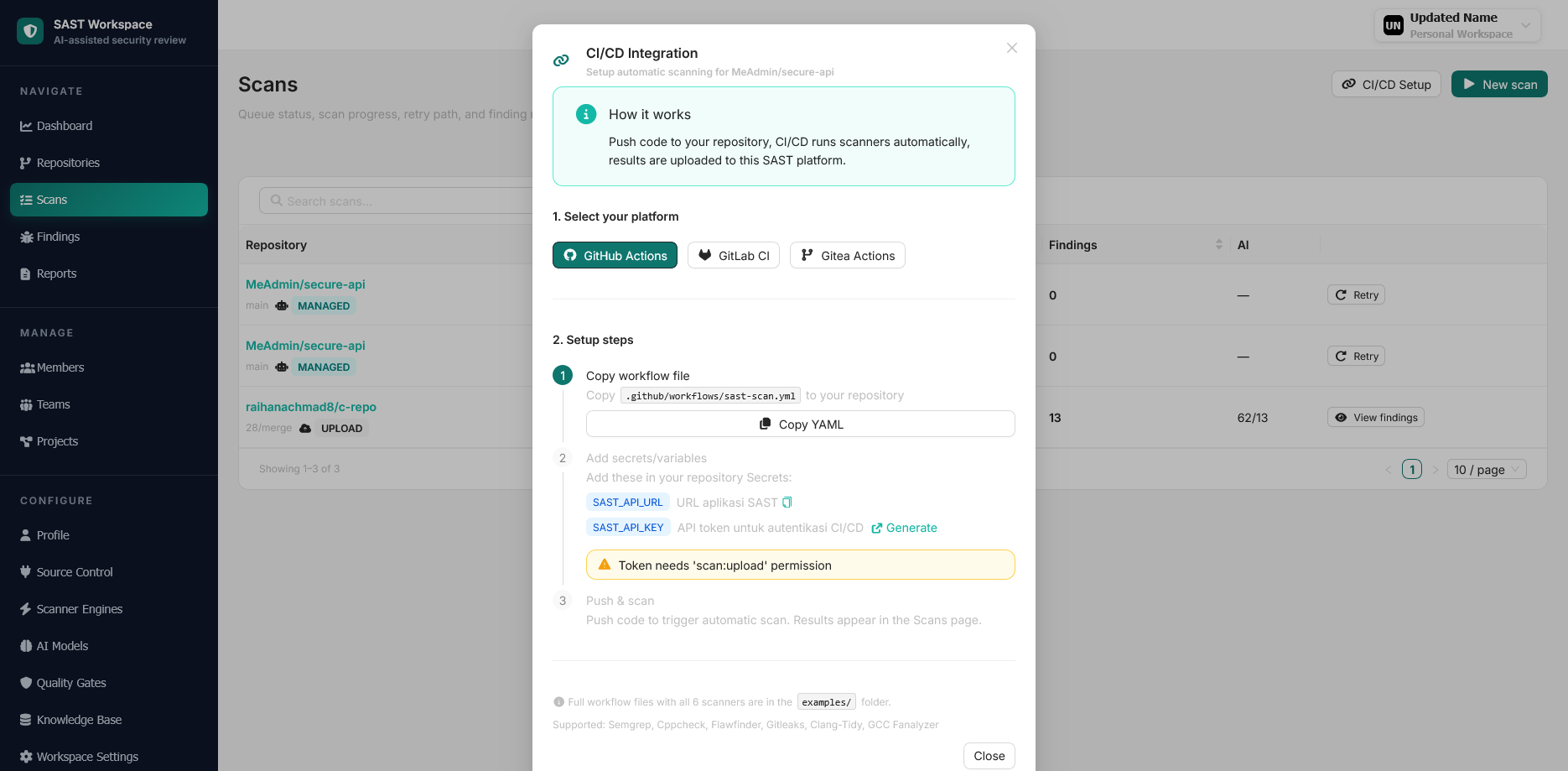
- SAST Scanning:
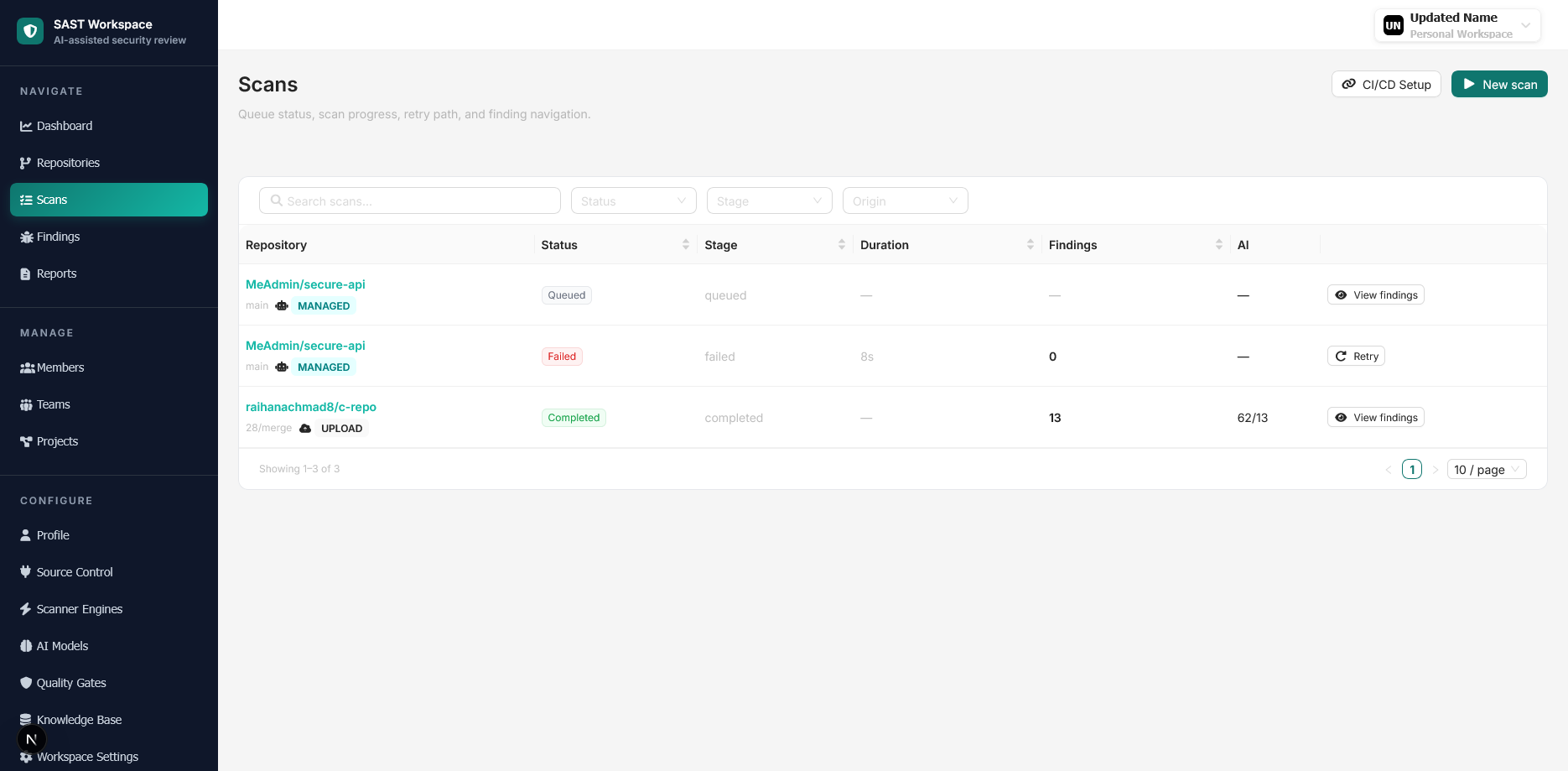
scans,scan_results, andfindingstables model Semgrep, Gitleaks, and Flawfinder runs with policies - AI Verification:
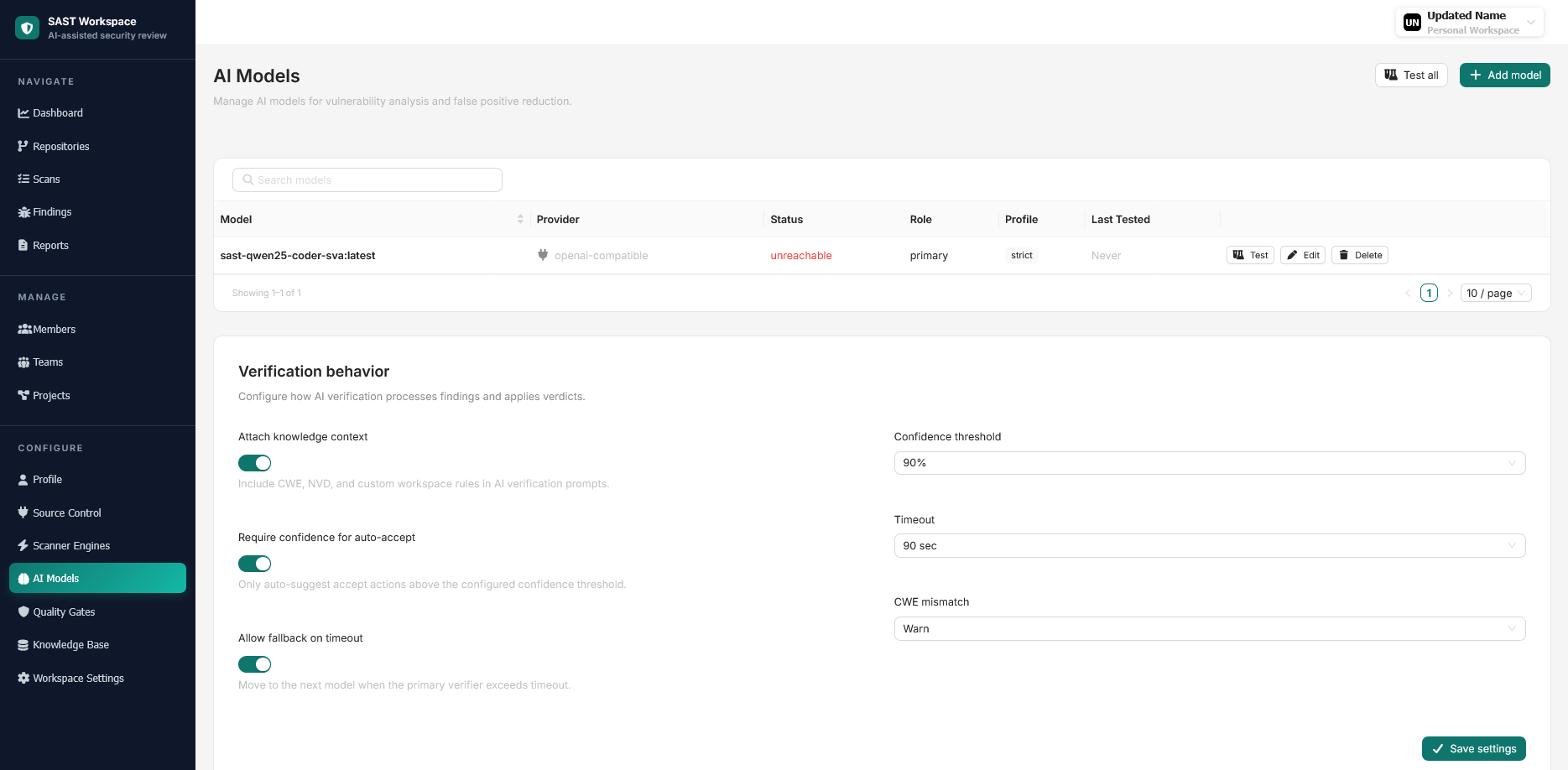
ai_verificationsandai_modelsmodel a model-agnostic verification layer with verdicts, confidence, and fix suggestions - Reports, webhooks, quality gates, and scheduled scans: all present as tables in the 41-table schema
Technical Decisions
- Next.js 16 App Router with
proxy.tsfor route protection and server components - Drizzle ORM for a SQL-first schema that stays close to the database
- jose JWT with HS256, short access tokens, and server-side session validation
- bcryptjs at 12 rounds for password hashing
- Ant Design for the enterprise UI surface
- Zod across the stack, including strict environment validation in production
Challenges
- Designing a 41-table schema that supports the full thesis problem before the code for each part exists
- Keeping auth airtight as the foundation, since every later feature depends on it
- Maintaining a consistent naming style across the schema as the two domains grew
- Scoping the thesis so the implemented milestones stay shippable while the research agenda continues
Outcome
The project is on track for a June 2026 thesis defense with a working M4 foundation: secure auth, multi-tenant workspaces, role management, and a 41-table data model for the full SAST and AI domain. The remaining milestones build the scanning pipeline and AI verification on top of the schema already in place.
Final Thoughts
SAST Integration is the most ambitious project I have built, and it taught me to stage complexity. The schema forces the design thinking before the code, and the implemented foundation keeps the platform real while the research continues. Building it has sharpened my skills across security, full-stack development, and the discipline of a thesis timeline.